Describe How the Distribution of Freshwater Resources Affects Humans
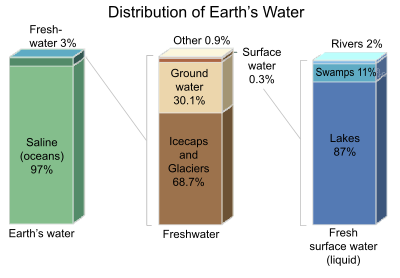
As a result less water becomes available for animals and plants. Earths oceans contain 97 of the planets water so just 3 is fresh water water with low concentrations of salts.
Distribution Of Water On The Earth S Surface Earth 103 Earth In The Future
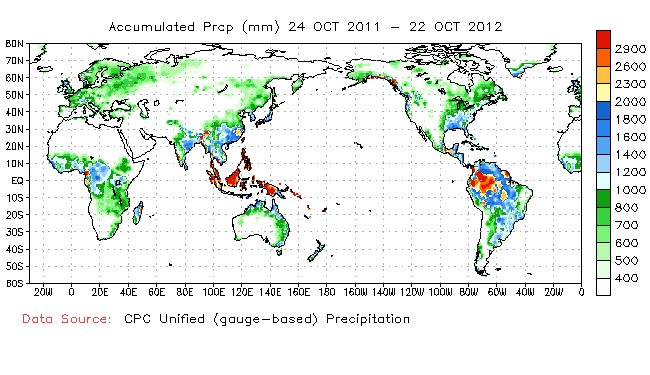
Low latitudes latitudes close to the equator receive more of the suns energy and much precipitation while higher latitudes.

. The average person. Although rivers account for only a small amount of freshwater this is where humans get a large portion of their water from. The right bar shows the breakdown of surface freshwater.
Water Distribution on Earth. The right bar shows the breakdown of surface freshwater. Find out more about Earths water.
And the absence of water can be even worse. Rivers make up 049 of surface freshwater. This means that more water is drawn from bodies of freshwater to support the water needs of the population.
Diversions and Massive Changes. Shortages of water could become a major obstacle to public health and development. This natural process can be greatly accelerated by human activities that remove vegetation from soil.
Although rivers account for only a small amount of freshwater this is where humans get a large portion of their water from. Many people do not have access to clean water to drink or to wash with. A number of forces continue to seriously affect our natural water resources.
The causes of freshwater pollution are varied and include industrial wastes sewage runoff from farmland cities and factory effluents and the build-up of sediment. Runoff from agricultural and urban areas hurts water quality. Currently 700 million people live in water-stressed areas.
People cannot live without food. Draining of wetlands for development depletes habitats. The source document for this Digest states.
Most fresh water is trapped as ice in the vast glaciers and ice sheets of Greenland. We rely on water for our food our health our livelihoods and for fun and leisure. A storage location for water such as an ocean glacier pond or even the atmosphere is known as a reservoir.
Water withdrawal for human use shrinks and degrades habitats. But water can also take away life. World Water Distribution and Supply.
Sometimes there just is not enough water and sometimes the available water is unclean and unhealthy. Changes to our water resources affect many sectors including energy production infrastructure human health agriculture and ecosystems. Movement of soil components especially topsoil from one place to another usually by wind flowing water or both.
The following discussion does not provide an exhaustive survey of all human effects but emphasizes those that are relatively widespread. The removal destruction or impairment of natural ecosystems are among the greatest. In other words where resources are located.
Currently the United Nations Childrens Fund UNICEF and the World Health Organization WHO estimate that 11 billion people lack access to a water supply and 26 billion people lack adequate sanitation. Humans affect rainforests whenever they take natural resources from them such as trees. Of freshwater 69 resides in glaciers 30 underground and less than 1 is located in lakes rivers and swamps.
Most of this water is locked up in ice and another 209 is found in lakes. Potential effects include increased flooding and drought water quality impairment and salt water intrusion to coastal water supplies. Most of this water is locked up in ice and another 209 is found in lakes.
Even though fresh water is renewable there is not always enough of it in a given place at a given time. Humans are facing a worldwide water crisis according to the United Nations. The remaining 97 resides in the ocean.
Some resources are essential for survival whilst others are needed to maintain a standard of living. By 2025 this number is expected to grow 18 billion about 25 of the world population. Resource distribution refers to the geographic occurrence or spatial arrangement of resources on earth.
The increasing consumption of water comes with increasing population. Wrong use of the land Destructive land use practices that result in vegetation loss can have negative impacts on freshwater ecosystems. Water is life as the saying goes.
Human activities can also reduce water supplies in an area. By volume and mass sediment is our greatest water pollutant. Many of these are primarily the result of human actions and include ecosystem and landscape changes sedimentation pollution over-abstraction and climate change.
The range in human activities that affect the interaction of ground water and surface water is broad. They affect the quality of rainwater and of water resources both above and below ground and damage natural systems. The forests and native plant communities surrounding lakes rivers and wetlands help protect water quality and quantity by filtering and.
Distribution of Earths Water. The distribution of water on the Earths surface is extremely uneven. Looked at another way only one percent of the water on the Earths surface is usable by humans and 99 of the.
Learn vocabulary terms and more with flashcards games and other study tools. Humans reduce the natural water supply or transport water to other places. They also contribute to the pollution worldwide which affects all areas including rainforests.
Resources are things that people use. Any particular place may be rich in the resources people desire and poor in others. Wastes that people dispose of can pollute the air the land and water resources.
Changes will vary in different regions of the United States. Although water covers about 70 percent of Earths surface only a small percent of that water is freshwater and even less of that is easily accessible to the billions of organisms. Humans use six times as much water today as they did 100.
Start studying Human impacts on Fresh water resources. Availability of freshwater is vital to live on Earth yet freshwater makes up a tiny fraction of all the water available on the planet. Water ShortagesWater shortages occur when people use water faster than the water cycle can replace it.
Human activities commonly affect the distri-bution quantity and chemical quality of water resources. Rivers make up 049 of surface freshwater. Only 3 of water on the surface is fresh.
The Distribution Of Water On In And Above The Earth U S Geological Survey

Land Distribution Land Use Pie Chart Landing
Distribution Of Water On The Earth S Surface Earth 103 Earth In The Future
No comments for "Describe How the Distribution of Freshwater Resources Affects Humans"
Post a Comment